
Saturday, October 31, 2009
Pat's Painting of Indian Valley Organic Farm
Lyn Tompkins sent along a photo of our classmate Pat's beautiful painting. Thank you Lyn...and thank you Pat!

Tuesday, October 27, 2009
40 Farmers Under 40
Here is a link sent to me by Lisa Chipkin (Thanks Lisa) from the Mother Nature Network. These are young farmers from across the nation.
40 Farmers Under 40: Readers Choice
40 Farmers Under 40: Readers Choice
Plant Propogation Notes from 10/14 and 10/21
Thank you Pam Scott for contributing class notes and photos for this blog:

Class Notes: 10/14
Growing Plants Through Strikes
- Taking a strike off of the mother plant – just pull off a piece of the original plant
- Better than cutting because cell walls stay intact if you pull and let the plant divide
- Remove all lower leaves – the stem cells can create leaves (which it already did) as well as roots (which it now will have the chance to do
- Cut top leaves at an angle
- Stick material into perlite at 45-degree angle
- Water daily but don’t disturb (by checking for roots) for 6 weeks
- This is a great way to keep the genetic material of the plant in tact
- After awhile, though, the vigor of the plant will wear down and need to propagate through sex to remain strong and vital
Mix for Making Good Potting Soil
- When you start plant from seed, it does not need rich soil; lean, well-drained, retentive soil
• 1/3 natural soil – so that the plant will be used to the culture of the native soil
• 1/3 sifted leaf mold – adds structure and retains water; can also use coco peat or peat moss; vermiculite also
• 1/3 sharp sand – for drainage; not salty Sandy Lawrence
- No matter what, cut in some native soil from where it will ultimately live; if not, the plant will be in shock when it goes to its final home
Great idea for compost: Create a ‘barrel’ with chicken wire; fill with oak leaves, in a year you’ll have good soil
Class Notes : 10/21
NYT ran an article on zero waste yesterday
SF made it illegal to throw away food scraps
(very exciting stuff!)
What is propagation?
- How to grow. How to increase plant material. The many ways plant material can be spread and shared.
- Sexual propagation – blending of genetic material; annual and bi-annual plants always spread this way; sometime perennials too
- Asexual propagation – taking a strike or cutting and spreading the same genetic material
What does it mean to cultivate soil?
- To turn the wheel of life. Culture is a wheel. To create, clean culture in the ground. To go down into the ground, into the depths to dig down into, to weed.
Great suppliers – call for catalogues
1. Peaceful Valley Farm Supply
2. Harmony Farm Supply
To Create Strikes
- Months or weeks before, cut the lead off of the mother plant – encouraging it to send up other major stems to replace it
- When the plant is in seed, it wants to spread by seed; so look to divide plants when they are flowering but before they’ve gone to seed
- Now is a very good time to be doing this
- A good strike (the bit that has been pulled off) should feel woody at the base
- You want your strike to be no more than 8”, preferably less
- Remove the lower leaves – roots will grow from these stem cells
- Create a balanced strike – about ½ will go into the ground, the other ½ above the surface
- Seeds push material equally above and below ground. We need to create this same balance when we create plants from strikes.
- Put at 45-degree angle into perlyte
- Water daily, water deeply
Root Division
- Easiest way to divide a plant is to pull it apart. When not doing that to create a strike, can do by pulling small bits of the plant complete with roots
- Look for healthy root mass in mother plant
- Pull off woody base growth (or cut)
- Cut off most on top – especially biggest bits (more than I would have thought)
- If root exceedingly long, cut it too
- Looking to create balance
- Plant in lunch mix (see below)
- Fall is the season to be separating plants by root division!
- Oregano, tarrogon, sage – a lot of the herbs can be separated now

Hardening Seedlings
- When plants are grown from seeds, one thing to consider is that they cannot be planted outside until they’ve been ‘hardened’
- This means getting them acclimated to the outdoor conditions – this is after having been raised early on in a green house
- Harden plants by setting them outside for hours at a time until they spend a couple of nights outside; then they’re ready to be put into the ground
- Not as important in our mild climates as other places

Speedling Flats – made of white Styrofoam; every pocket is cone-shaped; easier for mass planting
- Planting soil should be peat-based – coco peat (or peat moss – try to avoid using); to help with water retention
- Cannot use sand because Styrofoam doesn’t absorb water so drainage is not an issue
- A little bit (not much) of native soil
- Pinch of perlyte (white stuff that you use for strikes)
- No compost – it is too rich

Wendy holds up plant for root division
Class Notes: 10/14
Growing Plants Through Strikes
- Taking a strike off of the mother plant – just pull off a piece of the original plant
- Better than cutting because cell walls stay intact if you pull and let the plant divide
- Remove all lower leaves – the stem cells can create leaves (which it already did) as well as roots (which it now will have the chance to do
- Cut top leaves at an angle
- Stick material into perlite at 45-degree angle
- Water daily but don’t disturb (by checking for roots) for 6 weeks
- This is a great way to keep the genetic material of the plant in tact
- After awhile, though, the vigor of the plant will wear down and need to propagate through sex to remain strong and vital
Mix for Making Good Potting Soil
- When you start plant from seed, it does not need rich soil; lean, well-drained, retentive soil
• 1/3 natural soil – so that the plant will be used to the culture of the native soil
• 1/3 sifted leaf mold – adds structure and retains water; can also use coco peat or peat moss; vermiculite also
• 1/3 sharp sand – for drainage; not salty Sandy Lawrence
- No matter what, cut in some native soil from where it will ultimately live; if not, the plant will be in shock when it goes to its final home
Great idea for compost: Create a ‘barrel’ with chicken wire; fill with oak leaves, in a year you’ll have good soil

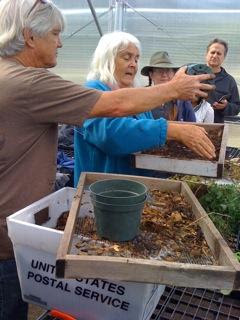
Steve and Wendy sift leaf mold
Class Notes : 10/21
NYT ran an article on zero waste yesterday
SF made it illegal to throw away food scraps
(very exciting stuff!)
What is propagation?
- How to grow. How to increase plant material. The many ways plant material can be spread and shared.
- Sexual propagation – blending of genetic material; annual and bi-annual plants always spread this way; sometime perennials too
- Asexual propagation – taking a strike or cutting and spreading the same genetic material
What does it mean to cultivate soil?
- To turn the wheel of life. Culture is a wheel. To create, clean culture in the ground. To go down into the ground, into the depths to dig down into, to weed.
Great suppliers – call for catalogues
1. Peaceful Valley Farm Supply
2. Harmony Farm Supply
To Create Strikes
- Months or weeks before, cut the lead off of the mother plant – encouraging it to send up other major stems to replace it
- When the plant is in seed, it wants to spread by seed; so look to divide plants when they are flowering but before they’ve gone to seed
- Now is a very good time to be doing this
- A good strike (the bit that has been pulled off) should feel woody at the base
- You want your strike to be no more than 8”, preferably less
- Remove the lower leaves – roots will grow from these stem cells
- Create a balanced strike – about ½ will go into the ground, the other ½ above the surface
- Seeds push material equally above and below ground. We need to create this same balance when we create plants from strikes.
- Put at 45-degree angle into perlyte
- Water daily, water deeply
Root Division
- Easiest way to divide a plant is to pull it apart. When not doing that to create a strike, can do by pulling small bits of the plant complete with roots
- Look for healthy root mass in mother plant
- Pull off woody base growth (or cut)
- Cut off most on top – especially biggest bits (more than I would have thought)
- If root exceedingly long, cut it too
- Looking to create balance
- Plant in lunch mix (see below)
- Fall is the season to be separating plants by root division!
- Oregano, tarrogon, sage – a lot of the herbs can be separated now

Looking to create a balance of roots and tops
Hardening Seedlings
- When plants are grown from seeds, one thing to consider is that they cannot be planted outside until they’ve been ‘hardened’
- This means getting them acclimated to the outdoor conditions – this is after having been raised early on in a green house
- Harden plants by setting them outside for hours at a time until they spend a couple of nights outside; then they’re ready to be put into the ground
- Not as important in our mild climates as other places

Wendy puts a strike in perlite
Speedling Flats – made of white Styrofoam; every pocket is cone-shaped; easier for mass planting
- Planting soil should be peat-based – coco peat (or peat moss – try to avoid using); to help with water retention
- Cannot use sand because Styrofoam doesn’t absorb water so drainage is not an issue
- A little bit (not much) of native soil
- Pinch of perlyte (white stuff that you use for strikes)
- No compost – it is too rich
Wednesday, October 21, 2009
The Fungus Fair!
Need I say More?
The 38th Annual Fungus Fair will take place
Saturday Dec. 1, 10 a.m.–6 p.m.
Sunday, Dec. 2, 12–5 p.m.
at the Oakland Museum of California
(presented by the Mycological Society of San Francisco)Sunday, Dec. 2, 12–5 p.m.
at the Oakland Museum of California
The "P" Word (discussing Population Control)
Last week, in the course of a conversation about the future of food, the "P" word came up...Population.
Here is a link to The Worldwatch Institute, a highly respected organization whose mission is:
"Worldwatch Institute delivers the insights and ideas that empower decision makers to create an environmentally sustainable society that meets human needs. Worldwatch focuses on the 21st-century challenges of climate change, resource degradation, population growth, and poverty by developing and disseminating solid data and innovative strategies for achieving a sustainable society."
Here is a link to The Worldwatch Institute, a highly respected organization whose mission is:
"Worldwatch Institute delivers the insights and ideas that empower decision makers to create an environmentally sustainable society that meets human needs. Worldwatch focuses on the 21st-century challenges of climate change, resource degradation, population growth, and poverty by developing and disseminating solid data and innovative strategies for achieving a sustainable society."
Friday, October 16, 2009
Seedy People

Flax seed, saved and winnowed on the Indian Valley Farm
Let's accept the facts... We are all seedy people. Whether we like it or not, we come from seed. Along with the rest of flora and fauna on our planet, we are a great blended genetic mystery, born from seed. So... there's one big thing we have in common. Maybe if we focus on that we can get along a little better.
Yes, of course we find differences amongst us living organisms of planet Earth. Unbelievably complex differences...so many amazing adaptations we've been able to work out over the eons. Thank goodness for these differences. Diverse and together - that is the only way all us seed-born creatures have been able to stay here. How about we honor each other, especially for our differences... all the while remembering that every one of us came from the same place.
On this tropical storm Wednesday, we made our way through the series of small standing water lakes that is Marin county after 5-6 inches of rain, to the College of Marin classroom to listen to Wendy Johnson who reminded us of our seedy start. This led to a discussion of Sexual vs Asexual (or Vegetative) reproduction. Wendy mentioned that her 7th grade students get very attentive when the word "Sexual" comes up at the beginning of class. I tired it out on my Middle School students the next day, and sure it enough, works like a charm. Only problem is that my daughter sat in the front row in one of the classes, and, needless to say, she was horrified. Her head actually fell onto the table with a loud thud.
We talked about Comfrey, known for both a capacity to easily reproduce by root division (stick a small piece of root in the ground) and its healing qualities for almost any ailment. As I get to know plants better over the years, I've come to respect perennial hard-workers. They seem to garner the most concentrated beneficial nutrients and essences for us humans. Is it a coincidence that many ancient perennial crops, like fig, artichoke and olives, are top the lists of "Food We Should Eat?"
Speaking of figs...it turns out Vegetative Propagation came first in terms of human agriculture. Figs were first. This is a link to an article about the discovery of evidence, outside of Jericho that asexual fig trees were shared amongst communities. This was 11,400 years ago, well before the use of written language, and also before the rise of agriculture in the Fertile Crescent.
Wendy made a list of essential reading about seeds, botany and propagation. Here it is:
Botany For Gardners by Brian Capon
Botany In A Day - The Patterns Method of Plant Identification Thomas J. Elpel's Herbal Field Guide to Plant Families
Seed To Seed by Susan Ashworth
The Secrets of Plant Propagation
Plant Propagation
The Lives of A Cell
The Metamorphosis of A Plant by Goethe
Goethe, the famous German author of The Sorrows of Young Werther and Faust, was an amateur botanist. He took a six week "plant walk" in the Swiss Alps and his observations of a great pulsation that was the cycle of a plant. The plant as "process."
Here are four stanzas from a poem of Goethe's that by the same name The Metamorphosis of Plants (you'll find the full text at the link) that capture his sense of wonder in observation of the mystery, the great blending of genetic material that is life.
Twofold as yet, hasten on, destined to blend into one.
Lovingly now the beauteous pairs are standing together,
Gather'd in countless array, there where the altar is raised.
Hymen hovereth o'er them, and scents delicious and mighty
Stream forth their fragrance so sweet, all things enliv'ning around.
Presently, parcell'd out, unnumber'd germs are seen swelling,
Sweetly conceald in the womb, where is made perfect the fruit.
Here doth Nature close the ring of her forces eternal;

Steve Quirt winnows flax seedat IVC Organic Farm
Saturday, October 10, 2009
Untangling A Knot

County Line Harvest at the Dolcini Family Farm
If modern day food production is a giant knot, tying us down tight to a dysfunctional system, last Wednesday we met individuals who are tugging away to loosen and undo strands. These farmers are hard-workers and daring activists who are leading the way to bring us good food, grown in a healthy way.

David Retsky, County Line Harvest Farmer
Here is how Steve Quirt introduced David Retsky, County Line Harvest farmer: "He's a young guy who is doing everything right." Retsky rents 33 acres of rich bottomland below a reservoir on the Dolcini family ranch. The Dolcinis are a family with deep roots in Marin County and Retsky's work on their land has reinvigorated the property. Kittty Dolcini has been growing "incredible" strawberries and opened a farm stand at the corner of Petaluma-Pt. Reyes Road and Hicks Valley Road. Before touring County Line Harvest, we gathered round to listen as Kitty shared memories of a ranch childhood, a world where a kid might grab a cup and run-off to gather her own cool milk, half cream, fresh from the cow.

Kitty Dolcini shares stories, the joys and trials of ranch life

David Retsky and Steve Quirt talks about what it takes to successfully grow organic food
If you've got farming in your bloodstream and in your dreams, David Retsky recommends finding a piece of property to rent as there are a number of parcels for rent in the Northbay (California Farmlinks has listings). He is not cavalier about the work that goes into turning a profit on a small farm, but has a clear-headed way of talking about things that makes it sound so do-able. In his case, he fits together the puzzle pieces of Greenleaf Produce, five farmer's markets and a lot of direct marketing to restaurants and local grocery stores. He tells us of how he came to be farming this land, providing the Bay Area with exquisite produce - some American kitchen staples, some exotic specialties. As he speaks, a story of adventure and lessons learned unfolds. From a childhood in LA county to work on farms all over the world to borrowing money and searching for the perfect swath of land in a region that loves food,... Retsky has journeyed, made mistakes, and discovered something with each bend in the road. It is no coincidence that he is "doing everything right."

Some of the best Arugula you'll taste
We had an opportunity to sample Retsky's greens and, as an Arugula connoiseur, I will attest that his harvest is about as tasty as it gets (This stuff bites back!) His lettuce is tender, his kale smooth and buttery. Again, the Order Form posted on Retsky's office wall reveals a narrative. In this case, we're looking at hundereds of conversations with local chefs - what produce are they looking for? What is delicious and difficult to come by? - and travel to Europe to find the seeds that will add layers of subtle and not-so-subtle tastes to our meals. Gretsky points out the difference between the U.S. and Italy. Americans are easily confused by the strong taste of Raddiccio, he says, while Italians pick it up along with a pack of smokes at the corner market.

Retsky gives a lot of credit to his hands, farmers from Oaxaca
Although he makes organic farming look easy, the shift in Retsky's voice when he talks about the appearance of Purslane in his fields reveals the intensity of the constant dance with nature that is cultivation. You can hear the wheels turning in his head even as he takes us on a tour of his crops. Farming is a full-time mental and physical engagement with the natural world, a constant search for solutions and improvements. Retsky is a modern day food production pioneer, forging a better future on an historic piece of land.

Fennel
Contact Info for County Line Harvest:
David Retsky
PO Box 2742
Petaluma, CA 94953
707.769.1802
dretsky@gmail.com

Subscribe to:
Posts (Atom)